
Read Oswego County Deed Types
A deed states a transfer between a grantor and a grantee. That is only the beginning. Its legal effect depends on the language, the parties' authority, the signatures, the acknowledgments, and the surrounding title. The Oswego County index also places mortgages, discharges, judgments, liens, maps, and plats near the deed trail. Not all of those records transfer ownership.
| Deed Type | What It Does | Common Use |
|---|---|---|
| Warranty deed | Conveys the stated estate with covenants | Ordinary sale |
| Quitclaim deed | Conveys the grantor's existing interest | Interest cleanup or family transfer |
| Executor deed | Conveys under estate authority | Probate sale |
| Referee deed | Conveys under a court process | Foreclosure or partition |
| Tax deed | Records a tax-enforcement transfer | Completed tax sale |
A mortgage grants security, not the ownership estate a deed conveys. A lien is not a conveyance either. Nor is a lis pendens. Read the releases, satisfactions, assignments, and any related court docket before deciding whether an older entry still carries weight.
SearchIQS Coverage for Oswego Deeds
The Clerk's availability table covers deeds from May 7, 1816 to the present. Older index-book series are listed separately. Mortgages enter the modern table at 1963. Discharges begin at 2001. Maps carry modern index coverage from 1990, with plats reaching further back. A 2024 digitization project made the county's deed run searchable back to its creation. One caution applies. An index hit and a viewable image are not the same thing. The official SearchIQS coverage page separates each record class. You can see exactly what is indexed.
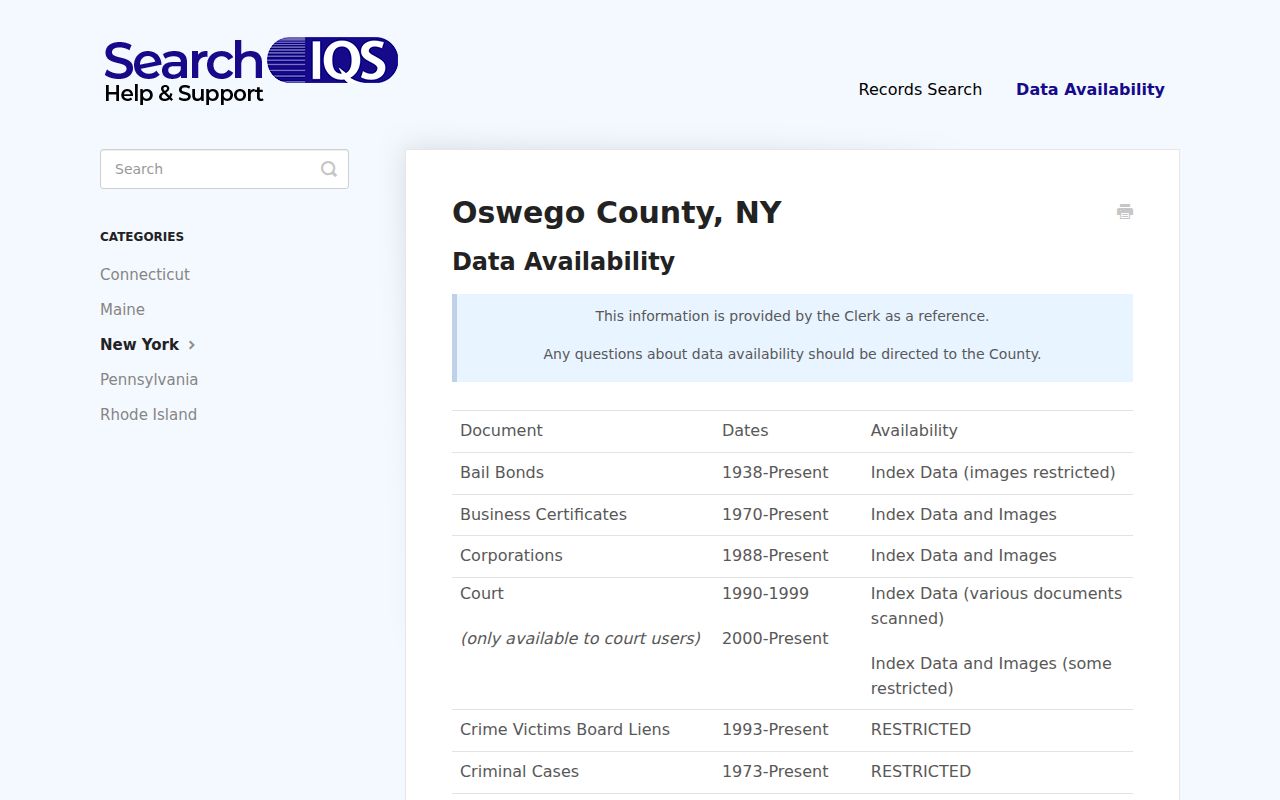
Check the row for your exact document type and year before contacting the office or Records Center.
Oswego Deed Search Controls
The search form offers more fields than most people use. Party 1, Party 2, grantor or grantee role, date range, document group and type, town, book and page, instrument number, and early-book modes all narrow results. Enter individual names surname first. Town indexing can be incomplete for older records. Party and book references are stronger anchors than a town-only query.
| Field | Use | Caution |
|---|---|---|
| Grantor | Seller or transferring party | Search name variants |
| Grantee | Buyer or receiving party | Entity form must match |
| Date range | Narrow a known transfer | Allow recording delay |
| Book/page | Open an exact reference | Image may be unavailable |
| Early books | Historic index route | Staff or paper follow-up may be needed |
The Oswego County Grantor-Grantee Index
Start with the newest deed you know. The grantee receives; the grantor transfers. Read the legal description and the prior deed reference instead of trusting names alone. Then look up the grantor's own earlier acquisition, this time as grantee. Keep repeating the cycle. Stop when you reach the desired date. You can also stop at a parent tract, an estate, a court order, or a missing image that changes the path.
- Find the latest purchase deed with the current grantee.
- Copy its grantor, date, description, and prior reference.
- Search that grantor as a grantee in an earlier period.
- Repeat, moving to index books or staff help when images end.
- Grantor
- The party transferring an interest.
- Grantee
- The party receiving an interest.
- Chain of title
- The ordered series of conveyances affecting the same land.
- Book and page
- The recorded-volume reference used to retrieve an instrument.
Older Oswego Deed Books
The archival index reaches surprisingly far back. It describes deed indexes from 1791 and deed typescripts covering 1816 through 1960. It also lists mortgages, maps, plats, lien dockets, and title-search material. Oswego County was carved from Oneida and Onondaga counties in 1816. An early chain may therefore cross into parent-county records or state land-patent history. The Records Center at 384 East River Road is a fallback channel worth trying. The FamilySearch catalog is another.
Directories, historic owner maps, newspapers, and probate indexes help resolve names and old addresses. Treat them as finding aids only. Confirm every result in the deed book or official file before calling anyone an owner.
Recorded Maps Explain Oswego Deeds
A tax map, a subdivision plat, and a metes-and-bounds deed do different jobs. SearchIQS lists historic plat coverage and later map indexes. The archival index describes Maps 1 through 40 and Plats 1 through 12. If the deed cites a map, exception, easement, right-of-way, or parent tract, retrieve every referenced item. Pull every referenced document. The GIS parcel cannot replace that text.
Obtain an Oswego County Deed Copy
Online images may require a SearchIQS account or subscription. The County Clerk offers free public computers at 46 East Bridge Street. Staff help is available on weekdays. Regular hard copies run 65 cents per page with a $1.30 minimum, though certified-copy charges should be confirmed directly. Bring the party names, document type, recording date, and book and page. For older material, ask whether the Clerk or the Records Center holds the volume.
A plain image serves research. A certified copy carries the Clerk's certification. Neither substitutes for a professional title examination. If a web image is missing, request the document rather than assuming the instrument was never recorded.
Recorded, not guaranteed. Oswego County deed records show filed instruments, not marketable title, priority, enforceability, or every unrecorded interest.
Oswego Encumbrances Around a Deed
A deed search should not stop at the conveyance when title history is the question. SearchIQS lists mortgages from 1963, discharges from 2001, federal tax liens with differing index and image periods, judgments, satisfactions, lis pendens, mechanic liens, hospital liens, welfare liens, UCCs, maps, and plats. Search the grantee and prior owners under exact and variant spellings. Match each result to its party role, date, and land description before assigning it to the parcel.
A mortgage does not vanish when the land later sells. Locate the discharge. Match it to the original book and page. A judgment needs its satisfaction or court disposition. A lis pendens signals litigation, not its outcome. For foreclosure, partition, quiet title, or tax-certiorari matters, pair the recorded notice with WebCivil Supreme or NYSCEF. Request the actual file where access permits.
Estate transfers follow another route entirely. Search WebSurrogate for the decedent. Request hard-filed material when necessary. Then locate any executor or administrator deed at the County Clerk. The archival index's Surrogate real-estate-sale series can explain nineteenth-century transfers that look nothing like a modern voluntary sale.
Oswego Deed Fraud Checks
Oswego County offers a free monitoring service. It watches public filings for a name you register. The service covers deeds, mortgages, discharges, judgments, and liens. Because the search is name-based, a notice may involve someone else entirely. Open the instrument behind the alert. Compare the parcel number and party address, then call the Clerk before assuming fraud. The program works well as an early warning. It does not replace periodic deed review or a full title examination.
Watch for mailed offers selling pricey copies of your deed records. The Clerk's regular-copy cost sits far below what some private solicitors charge. Before paying, confirm what you are actually buying. It could be an informational print, a certified copy, an index entry, or something else. Official access is the cheaper route.
Deed Search Notes to Retain
Keep a record of every Oswego County deed search you run. Save the query plus the grantor and grantee roles. Also record the deed type and both the execution and recording dates. Add the book, page, and image page count. Record the consideration language, municipality, and complete legal description. Note any prior reference along with each exception or easement.
A concise abstract of these fields pays off later. It makes the next backward or forward property search reliable. It also shows whether you reviewed the actual image. That may be only an index entry, or a certified copy from the deed records.