
Tracing Former Owners of a Oswego County Property
SearchIQS is the first stop for recorded transfers, offering deeds from 1816 onward thanks to the 2024 digitization project. The archival index reaches deeper, pointing to deed indexes beginning in 1791 along with deed typescripts, early maps, mortgages, tax material, and court records. Directories and newspapers fill in names and addresses nicely. They never replace the conveyances themselves.
| Source | Years It Covers | Where Held | What It Shows |
|---|---|---|---|
| SearchIQS deed index | 1816-present | County Clerk and SearchIQS | Grantors, grantees, and deed references |
| Historic deed indexes | From 1791 in the finding aid | Clerk and Records Center | Earlier parties and volumes |
| Maps and plats | Series-dependent | County Clerk | Parent tracts and platted lots |
| Rolls and directories | Series-dependent | Records Center and libraries | Assessed owner or address context |
Always begin with the latest deed, no matter which era you are chasing. Its prior-reference clause and legal description form a controlled path into the older books. Reach for a directory only when a spelling, street, or occupant clue is missing.
Oswego Deeds Reach to 1816
A Clerk project finished in 2024 put the county's deed run back to formation online. Coverage still varies by record type and image status. The official availability table breaks out deeds, mortgages, maps, plats, liens, and judgments.
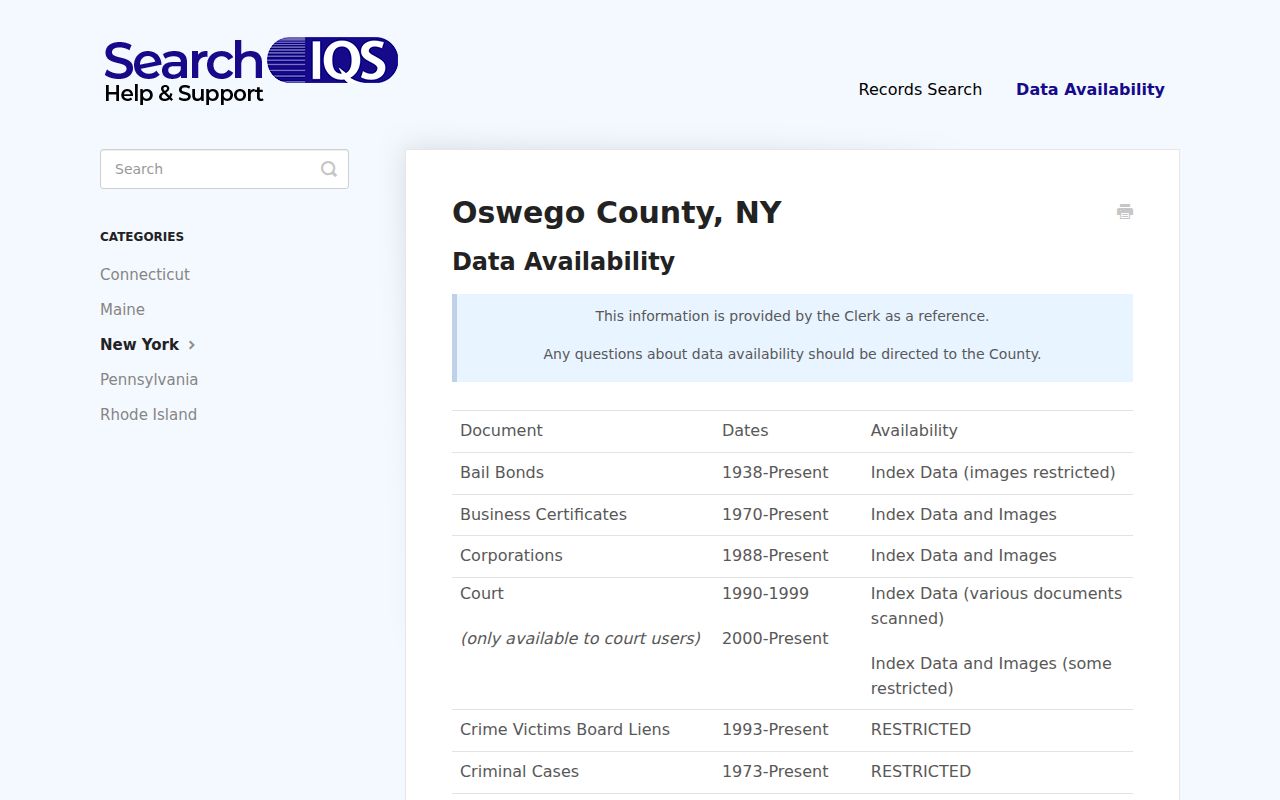
Note: an index entry may still call for an office request before a readable or certified image is available.
Directories Support Prior Owners
Oswego Public Library holds city directories from 1852 forward. A digitized run covers 1852 through 1929, plus newspapers reaching deep into the nineteenth century. Fulton library material adds local newspapers, photographs, maps, and yearbooks. Search an address in two directory years and note the label. The entry may say owner, occupant, widow, or business. Then test that name in the deed index. A directory label is context, never title evidence.
Walking the Oswego County Deed Chain Backward
Find the latest deed by book and page, or by the current grantee. Read the prior owner as the grantor. Then locate that grantor's own earlier acquisition as a grantee, comparing descriptions at every step. A shared surname alone proves nothing about the chain. It must carry the same lot, parent tract, map, or bounds to count.
- [STEP 1 - find the current owner's purchase deed (owner as grantee)]
- [STEP 2 - read the prior owner (the grantor) from that deed]
- [STEP 3 - search that prior owner as grantee to step back again]
- [STEP 4 - note the online cutoff; continue in the deed books for earlier years]
- Grantor / grantee
- [Seller / buyer on a deed.]
- Chain of title
- [The ordered sequence of past deeds.]
- Legal description
- [Why it beats the street address for old records.]
Probate Changes the Oswego Chain
Oswego's archival index covers Surrogate real-estate-sale records from 1816 through 1896. It also includes wills, letters, settlements, and estate registers. A decedent, executor, guardian, or court sale can break a tidy buyer-seller pattern. Search WebSurrogate for the estate. Request any hard-filed record, then find the fiduciary deed at the County Clerk.
Parent Counties Extend the History
Oswego County formed in 1816 from Oneida and Onondaga. A chain reaching that date may continue into a parent county, a state patent, a military tract, or an older grant. The archival index lists material predating 1816. So the earliest online deed is not always the first transaction touching the ground.
How Far Back Oswego County Ownership Records Go
No universal stopping point exists. SearchIQS, older indexes, Clerk books, Records Center series, FamilySearch films, and maps all overlap. Parent-county sources do too. When an image ends, record the index provenance and request the official volume. The sources publish no courthouse-fire gap. None should be assumed.
Lawful use. Former-owner research supports house history, estate work, and title diligence. Never use it to track or harass a living person.
Oswego Chain Research Worksheet
Build one row per transfer, capturing the recording date, grantor, grantee, deed type, book and page, legal-description match, and prior reference. Include any unresolved issue in the same row. Move backward only when the land description and the party trail both connect. A deed conveying several tracts needs a mark showing which clause covers the subject parcel. When a deed conveys only a share, use caution. Never label the grantee as receiving the whole estate without further evidence. Precision here saves hours later. Mortgages, releases, judgments, and newspaper notices can explain events between deeds. Keep them as supporting rows, not owner changes. A directory entry shows that someone occupied or ran a business at an address. A tax roll shows an assessed owner for a single year. Label each role exactly as the source states it.
Old Oswego Addresses Need Triangulation
For nineteenth-century Oswego, set the deed description beside an owner map, a city directory, an assessment series, and the newspapers. Streets change names. Numbers get reused. A modern parcel may descend from a much larger tract. Franklin Square, Montcalm Park, Kingsford, canal, mill, great lot, and subdivision names all work as search terms. The deed reference controls the chain. For Fulton, add Oswego Falls and village-era terms from before the 1902 charter. Canal Landing, riverfront mills, Broadway, and downtown routes can point toward contextual records. Translate each one into a street, parcel, map, and recorded description before trusting it.
Oswego Map References in Old Deeds
Older deeds may cite a great lot, block, subdivision, parent tract, canal edge, water line, road, or adjoining owner instead of a modern street number. Copy each reference exactly. Retrieve the cited maps or prior deeds. A present tax description, such as a lot-and-block shorthand, can bridge the modern roll to a historic plan, but do not stretch it past what the recorded sources support. If the chain hits a parcel split, trace both the parent deed and the new-lot conveyance. If it hits a merger, work out which earlier tracts fed the combined parcel. This land-first method beats chasing a familiar surname onto unrelated ground.